Mission Career College built a connected growth system from inquiry to cash
Mission Career College had demand, but not a reliable operating path turning demand into timely follow-up, enrollment, payment, and reporting. This engagement rebuilt the system end to end.
Mission Career College built a connected growth system from inquiry to cash
A 3-campus healthcare training institution needed more than more inquiries. It needed one operating path from demand capture to follow-up, enrollment, payment, and reporting.
At a glance
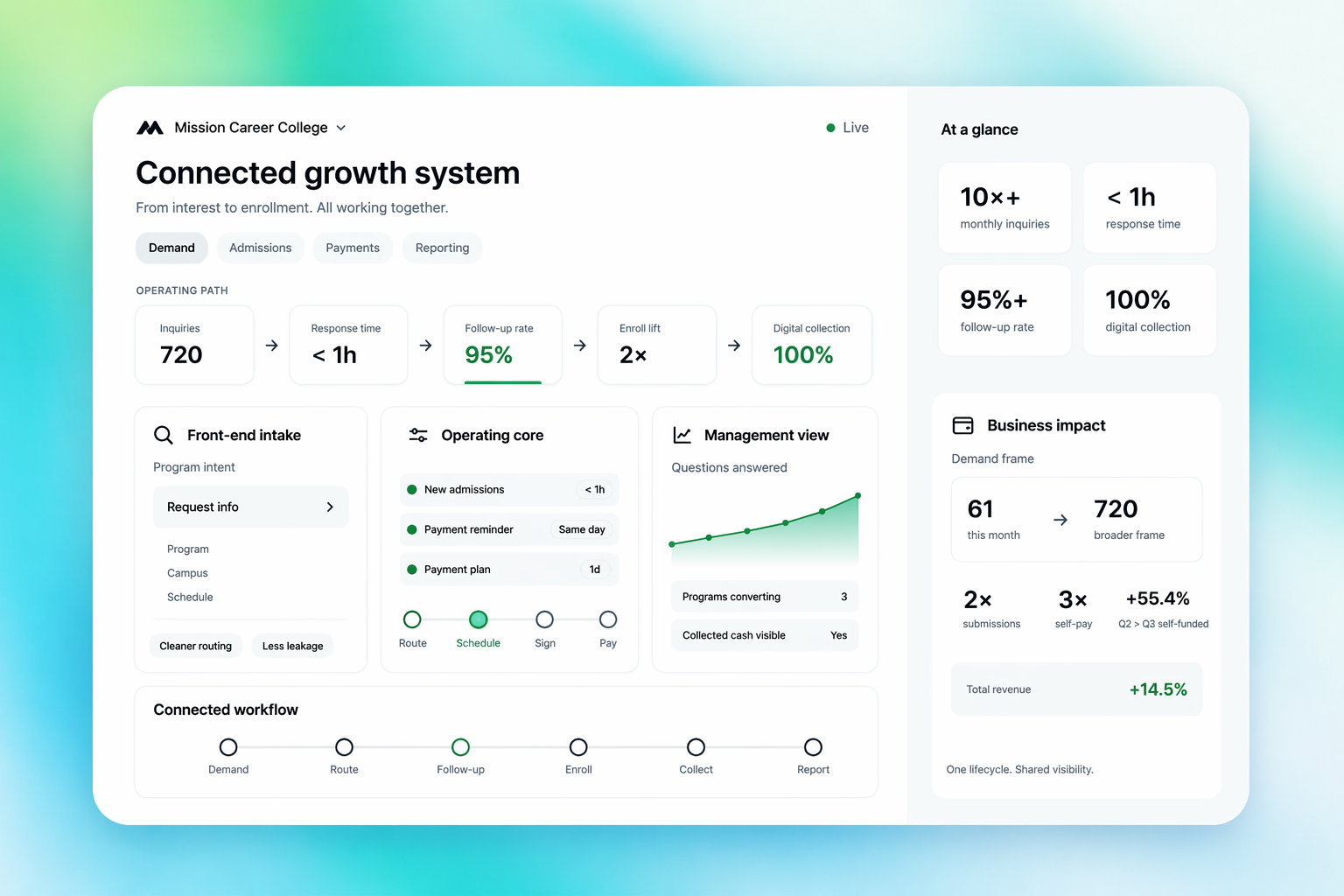
- More than 10x growth in monthly inquiries
- Response time reduced from 48+ hours to under 1 hour
- Follow-up consistency above 95%
- Tuition collection moved to a fully digital workflow
- Self-funded revenue increased 55.4% from Q2 to Q3 in one internal snapshot
Mission Career College had real demand across paid search, SEO, and new web properties. The constraint was not interest. The constraint was fragmentation. Inquiries entered through multiple forms and landing pages, admissions follow-up was uneven, enrollment documents and payment collection lived outside the core workflow, and leadership lacked a trustworthy view of what became revenue.
For a multi-campus career college with growing private-pay volume, that was not just an analytics problem. It was an operating-model problem. Marketing, admissions, enrollment, billing, and reporting were functioning as adjacent activities rather than as one system.
Call for change
The institution had enough demand and program volume to justify systemization. What it did not yet have was a shared operating model.
That gap created three business risks. First, high-intent inquiries could sit too long before human follow-up. Second, admissions and enrollment teams had to manage documents, signatures, payment steps, and status changes through too many manual handoffs. Third, leadership could not cleanly separate channel performance from operational failure because source data, pipeline activity, enrollment status, billing progress, and revenue visibility did not live in one dependable operating view.
The practical result was predictable: more demand would have created more leakage unless the handoffs behind the form improved.
What changed
We rebuilt the path from inquiry to cash around HubSpot as the operating core.
On the front end, web intake was standardized so new inquiries arrived with cleaner attribution, more consistent program intent data, and fewer avoidable routing errors. In the middle of the lifecycle, lifecycle stages, ownership rules, routing logic, SLA expectations, dashboards, scheduling workflows, and admissions tasking were redesigned so response discipline became explicit and measurable. On the back end, agreements, e-sign steps, payment links, reminders, reconciliation, and tuition-status visibility were digitized so self-pay activity could be tied back to the same record and surfaced in reporting.
At the management layer, reporting was reorganized around the questions leadership actually needed answered: Where is demand coming from? How quickly is it being worked? Which programs are converting? Which enrollments are becoming collected cash?
This is what made the engagement commercially meaningful. The work did not add a dashboard on top of broken handoffs. It changed the handoffs.
Why the system performed better
The system improved because each transition became more reliable.
Better page-to-form alignment improved intent capture. Routing and SLA logic protected speed-to-lead. Structured admissions workflows reduced ambiguity around ownership and next actions. Digital agreements and payment flows reduced post-admissions friction. Reporting connected acquisition, execution, and cash visibility in one operating rhythm.
In other words, the institution stopped treating demand, admissions, enrollment, billing, and reporting as separate projects. It started managing them as one lifecycle.
Business impact
Internal operating materials tied the rebuilt system to a substantial increase in measurable demand and a sharper operational response. Monthly inquiries rose from 61 to 720 in the broader reporting frame used for the public case. Response time moved from more than 48 hours to under 1 hour. Follow-up consistency exceeded 95 percent. Monthly enrollment submissions doubled. Tuition collection became fully digital.
Separate operating summaries also showed the downstream value of that systemization. Conservative records described average monthly self-pay collections increasing roughly threefold over the engagement period. A separate quarterly snapshot showed self-funded revenue increasing 55.4 percent from Q2 to Q3 while total revenue increased 14.5 percent over the same period. The important point is not any single metric in isolation. It is that demand growth, response discipline, enrollment throughput, collection workflow, and management visibility improved together.
Scope of work
- Revenue operations architecture
- HubSpot redesign and lifecycle design
- Lead routing and SLA logic
- Admissions workflow design
- Digital enrollment and document workflows
- Payment enablement and reconciliation visibility
- Dashboards, governance, and management reporting
Measurement note
This article is based on internal operating summaries and reporting captures prepared between March and April 2026, with supporting activity data from earlier operating periods. Where multiple internal views used different date windows, the published version prioritizes the narrower and more conservative metric frame. Relative lifts are emphasized intentionally. Revenue language reflects internal operating figures rather than audited financial statements.
Closing thought
If an institution is generating demand but still managing intake, follow-up, enrollment, and payment as disconnected functions, the bottleneck is usually not demand generation alone. It is the lack of a shared operating system behind the inquiry.
.png)