Mission Career College made paid search accountable to revenue
Paid search was creating opportunity, but the institution needed cleaner attribution, faster intake, and a simpler path from click to collected cash.
Mission Career College made paid search accountable to revenue
Paid demand was growing. The institution needed a cleaner path from search intent to follow-up, enrollment, payment, and reporting.
At a glance
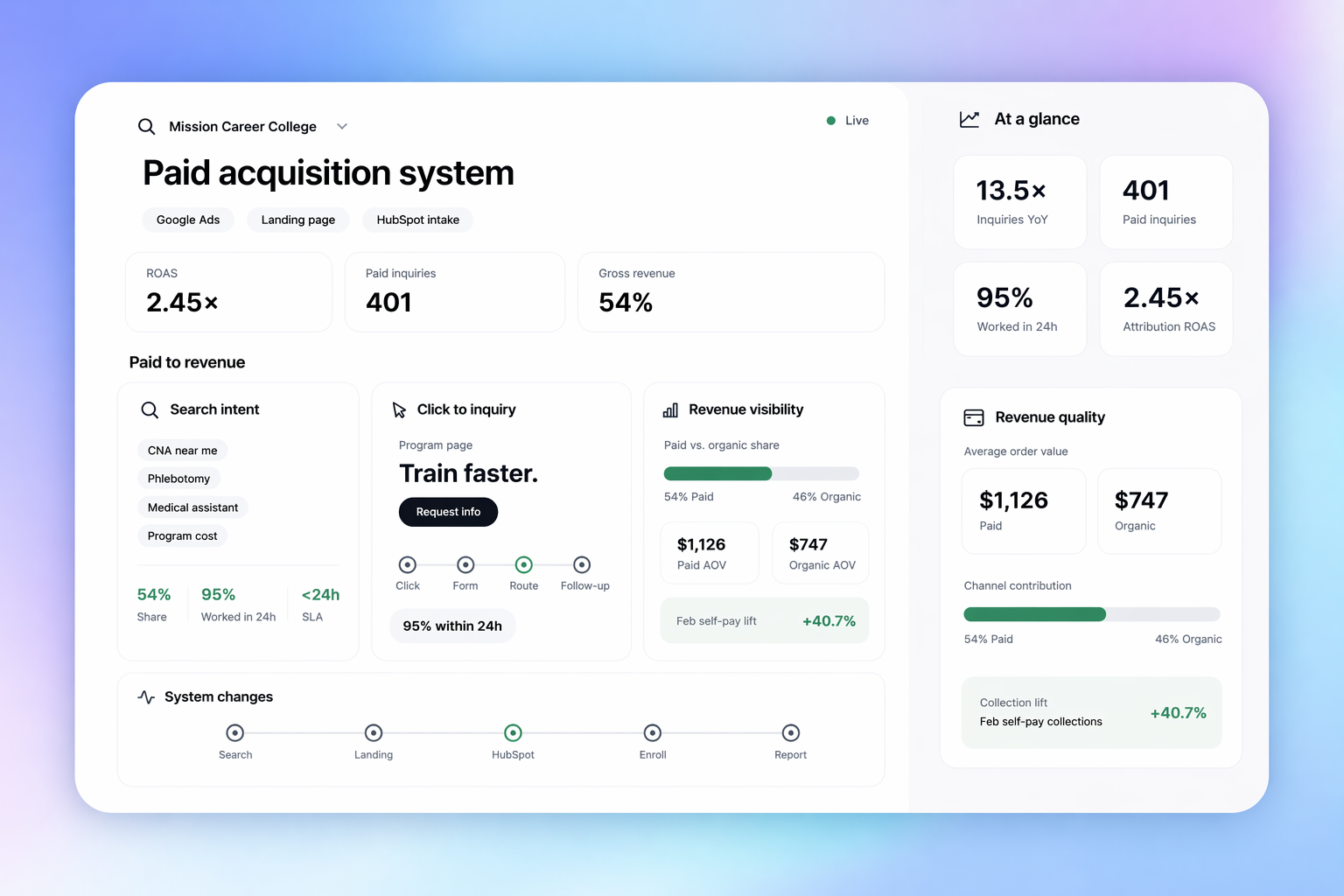
- January inquiries increased 13.5x year over year
- Paid contributed nearly half of January inquiry volume
- Paid generated roughly 54% of January gross revenue
- Conservative attribution documented 2.45x ROAS
- Paid average order value was about 51% higher than organic
By early 2026, Mission Career College no longer had a simple lead-volume problem. Inquiry volume had already accelerated sharply. The harder question was whether paid search was creating business value that leadership could trust.
Campaign reporting alone could not answer that. The institution needed to know which searches were producing qualified self-pay demand, whether those inquiries were being worked fast enough, and how paid compared with organic once revenue quality and payment conversion were taken into account.
Call for change
Paid search was creating opportunity, but the system around it was not yet designed to convert and measure that opportunity well enough.
As January demand climbed, the older operating model exposed its limits. Search intent could be captured, but the post-click experience, intake handling, follow-up cadence, and enrollment workflow still introduced avoidable leakage. That made channel evaluation harder than it should have been. A campaign could look productive at the inquiry level while still underperforming at the business level if routing, payment readiness, or reporting discipline were weak.
Leadership needed more than more leads. It needed paid acquisition tied back to business outcomes.
What changed
We rebuilt the paid acquisition system across five layers.
First, Google Ads was restructured around local, program-specific intent. Non-serving and redundant elements were removed, and ongoing optimization focused on relevance, lead quality, and conversion potential rather than on traffic volume alone.
Second, the landing and inquiry path was tightened. Program pages and next actions were made easier to understand so the query, offer, and conversion step aligned more cleanly.
Third, intake was centralized and cleaned up in HubSpot. Source capture, routing, and assignment logic were improved so paid inquiries entered the right workflow faster and with better visibility.
Fourth, the downstream enrollment path was simplified. Digital applications, standardized document packets, e-sign steps, and payment workflows reduced the lag between inquiry and readiness to pay.
Fifth, leadership reporting was rebuilt so channel evaluation could move beyond clicks and leads toward attributable revenue, order value, and collection signals.
Why performance improved
Paid search did not improve because of campaign structure alone.
The strongest gains came from the interaction between channel quality and post-click operations. Better search intent mapping improved lead quality. Cleaner page-to-form alignment improved conversion. Faster routing and follow-up reduced avoidable decay. Simpler digital enrollment and payment workflows made monetization easier. Closed-loop reporting made the channel easier to optimize because leadership could see both direct attributable return and the broader lift created by a stronger conversion environment.
This is why the case matters. Paid performance was not treated as a media-only problem. It was treated as a system problem.
Business impact
In January 2026, Mission Career College reached 821 total inquiries, up from 61 in January 2025. Paid contributed 401 of those inquiries, nearly half of total volume, while organic contributed 411. Despite similar inquiry volume, paid produced a slightly larger share of January gross revenue, roughly 54 percent versus about 46 percent from organic.
Paid also monetized at higher value. Internal reporting put paid average order value at approximately $1,126 versus roughly $747 for organic. That means paid inquiries were not just numerous. They were commercially stronger on a per-order basis.
Conservative leadership reporting documented 2.45x attributable ROAS for the paid program. Separate operating materials also showed that after workflow improvements, 95 percent of leads were worked within 24 hours with an average response time of approximately six hours. February self-pay collections rose 40.7 percent month over month, reinforcing that the channel was becoming easier to convert into actual cash collections rather than stopping at inquiry growth.
Scope of work
- Google Ads restructuring and optimization
- Program-level demand mapping
- Landing-page and inquiry-path alignment
- Attribution cleanup
- HubSpot intake and routing improvement
- Digital enrollment and payment workflow enablement
- Revenue reporting and performance analysis
Measurement note
This article is based on January and February 2026 operating reviews, an April 2026 Google Ads ROI summary, and related internal growth-system reporting. Paid return is presented as attributable ROAS, not as a formal incrementality study. Public copy prioritizes ratios, percentages, and relative comparisons over unnecessary internal financial detail.
Closing thought
If paid search is producing interest but not predictable revenue, the bottleneck is often between click and cash, not inside the ad platform alone.
.png)