Mission Career College turned its website into a non-paid demand system
The school did not have a simple website problem. It had a discoverability, clarity, and trust problem that was limiting non-paid demand.
Mission Career College turned its website into a non-paid demand system
The website was not failing as design. It was failing as infrastructure for discovery, trust, and inquiry conversion.
At a glance
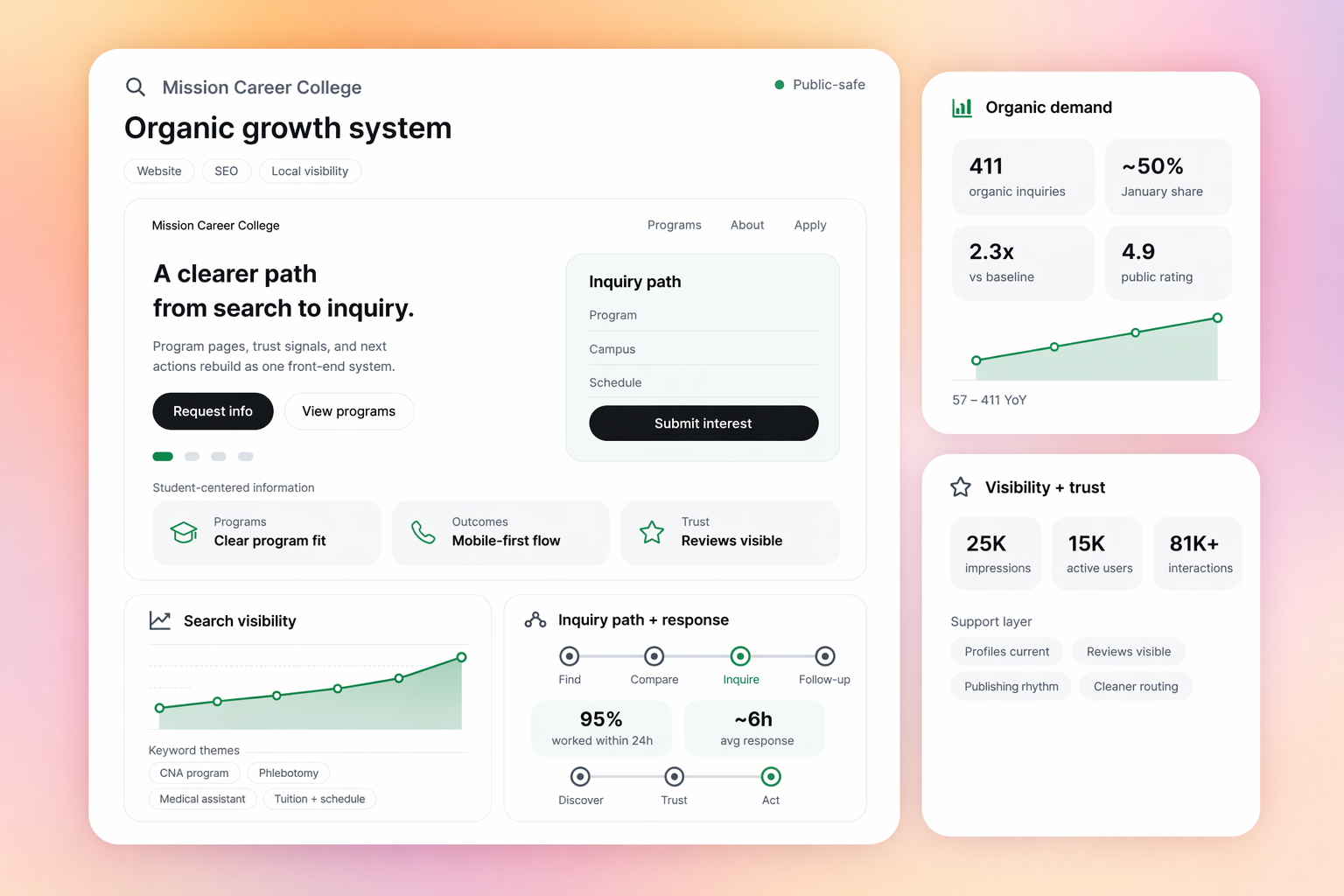
- Organic inquiries increased from 57 to 411 year over year
- Organic accounted for roughly half of January inquiry volume
- January demand ran at approximately 2.3x the FY2025 monthly baseline
- Public rating reached 4.9 on average
- Supporting reporting documented 25,000 impressions, 15,000 active users, and 81,000+ interactions
Mission Career College needed more than periodic content updates. It needed a coherent non-paid growth system that could improve discoverability, strengthen trust, clarify programs, and move prospective students from search to inquiry with less friction.
The website mattered here, but only as part of a broader operating path. Search visibility, page clarity, reviews, local profiles, inquiry handling, and admissions response all had to improve together for non-paid demand to become commercially useful.
Call for change
Before the rebuild matured, the institution's organic presence was not operating as a unified system.
Prospective students could find the school, but the digital experience did not consistently help them understand program fit, trust the institution, and take the next step with confidence. Search visibility, program-page clarity, local visibility, publishing discipline, and inquiry paths were not aligned tightly enough. More traffic by itself would have produced more leakage.
That is why this was never just a design refresh or an SEO cleanup. It was a front-end systems problem.
What changed
We rebuilt the non-paid growth layer end to end.
Program pages and public entry points were restructured around decision clarity, mobile usability, trust signals, and direct next actions. Inquiry pathways were simplified so visitors could move from discovery to action with less ambiguity.
Search Console analysis, keyword planning, competitor review, and editorial planning were brought into a more disciplined operating process so content decisions reflected actual search demand and program priorities. Publishing workflows were formalized across blogs, public program content, Google posts, and student-facing materials.
The trust layer was strengthened too. Public profiles were kept current, reviews became more visible, and content direction shifted toward clearer student-facing information and stronger public reassurance. Just as important, the handoff behind the form improved, so organic demand did not disappear into a slow response environment after capture.
Why the system performed better
Organic growth is strategically useful only when discovery, trust, conversion, and response discipline improve together.
Search visibility brought the right visitors. Better information architecture reduced confusion. Stronger reputation signals made the institution easier to trust. Clearer inquiry paths captured more intent. Faster routing and follow-up made that demand actionable.
The website stopped behaving like a brochure and started behaving like infrastructure.
Business impact
The January 2026 operating review showed organic inquiries reaching 411, compared with 57 in January 2025. Organic contributed roughly half of January's 821 total inquiries, confirming that non-paid growth had become a material part of the acquisition picture rather than a secondary channel.
January demand also ran at approximately 2.3x the FY2025 monthly baseline. Supporting digital operations reporting documented a 4.9 average public rating, 25,000 impressions, 15,000 active users, and more than 81,000 interactions. The same operating layer also supported 95 percent of leads being worked within 24 hours and approximately six-hour average response time.
Conservative operating summaries elsewhere in the project described weekly inbound inquiries increasing sixfold over four months and inquiry-to-enrollment conversion doubling year over year. That broader pattern is why this case is best understood as a front-end systems story rather than a pure SEO story. The work improved discoverability, trust, inquiry capture, and the handoff behind the inquiry at the same time.
Scope of work
- Website and information-architecture strategy
- Program-page restructuring
- SEO research and keyword planning
- Editorial planning and publishing workflows
- Local visibility support
- Review and reputation support
- Inquiry-path and conversion-flow design
- Admissions handoff improvement
- Organic reporting and growth analysis
Measurement note
This article is based on the January 2026 operating review, digital operations reporting, website and systems documentation, and internal implementation records. Public copy emphasizes counts, percentages, and directional change over unnecessary internal financial detail.
Closing thought
When a website becomes easier to understand, easier to trust, and easier to act on, organic growth stops being a side channel and becomes a real operating asset.
.png)