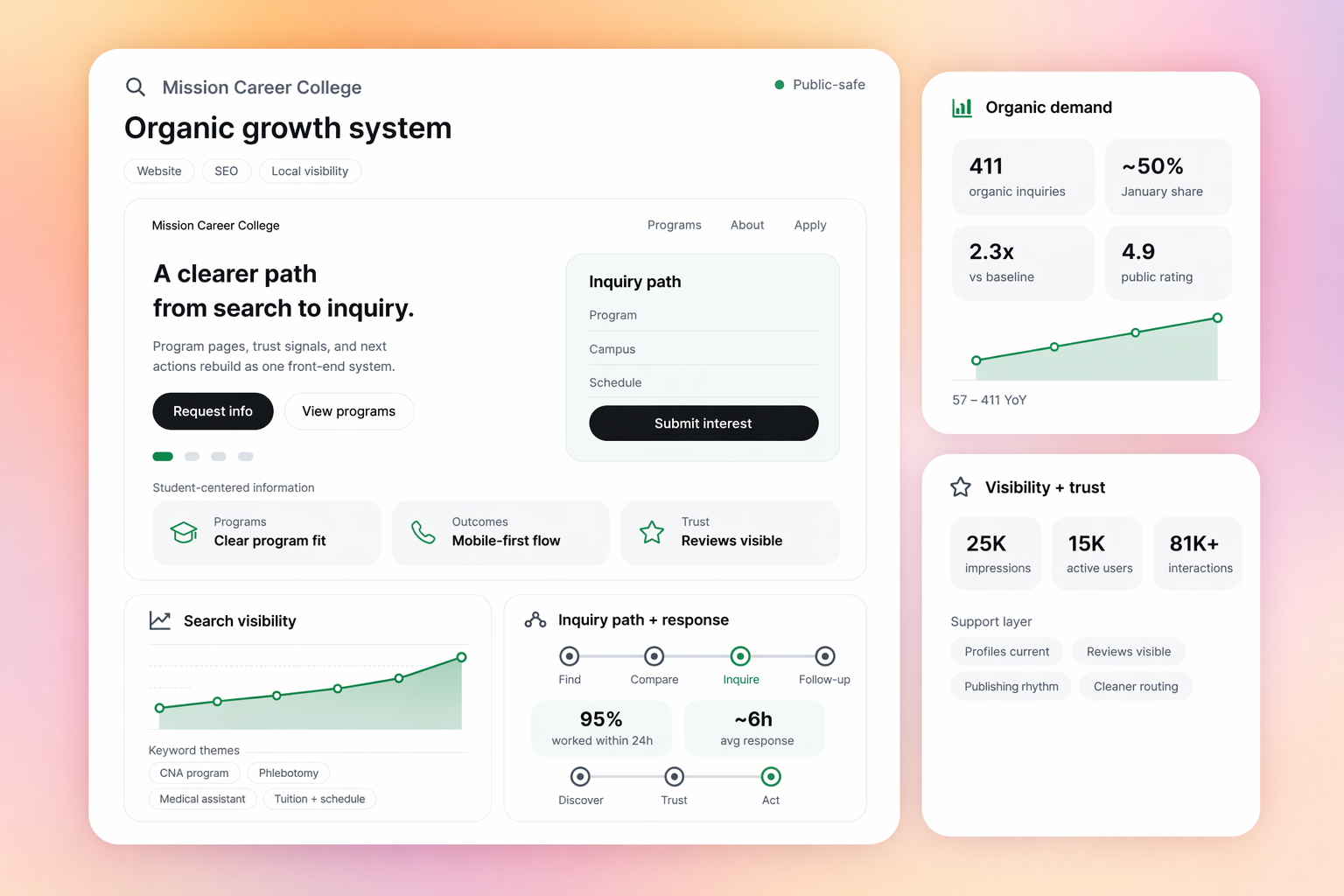
Mission Career College turned HubSpot into its admissions operating system
The school did not need a CRM that simply stored leads. It needed a working system for routing, follow-up, documents, class logic, payments, and reporting.
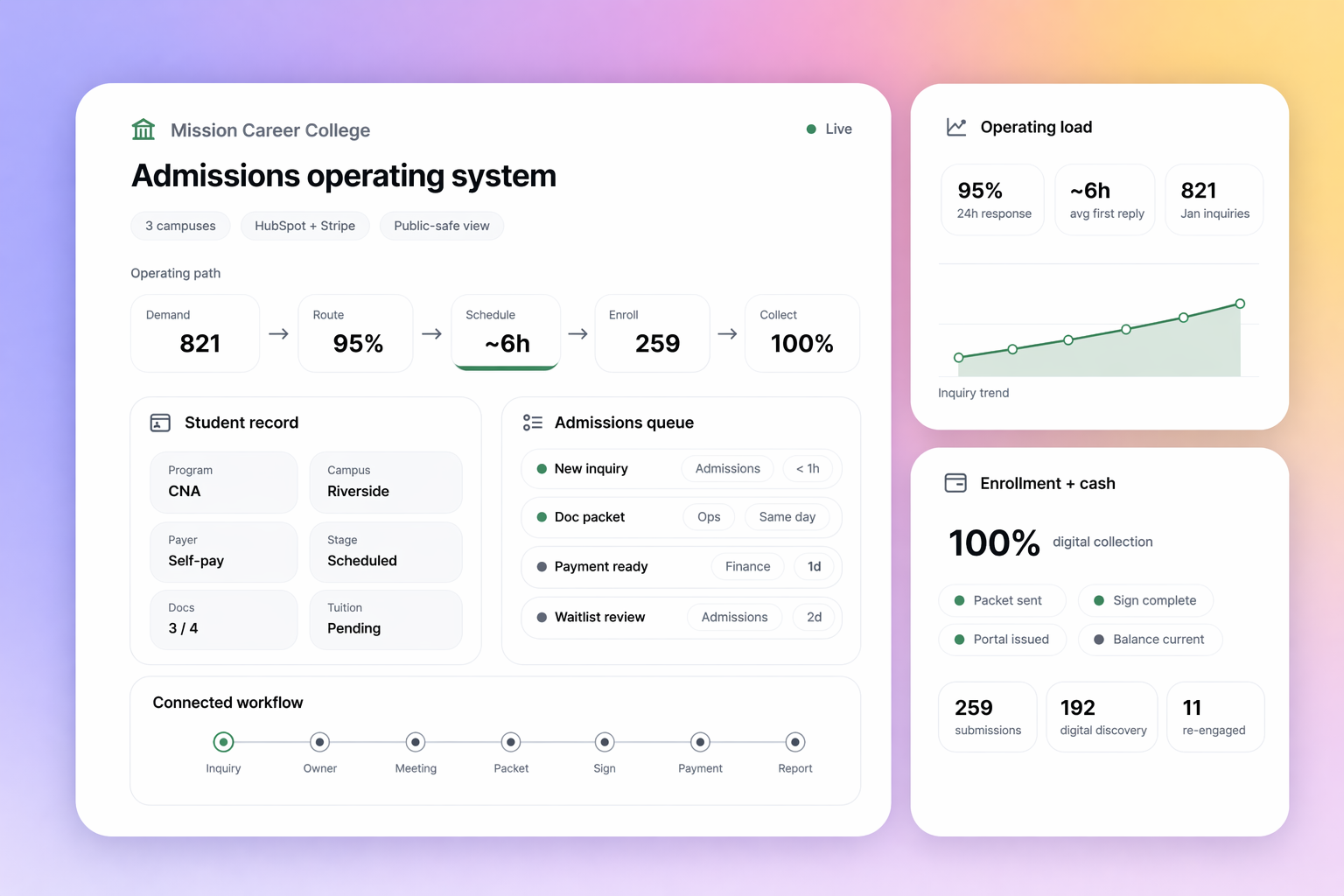
Mission Career College turned HubSpot into its admissions operating system
The institution did not need a better database. It needed one working system for routing, follow-up, scheduling, documents, payments, and reporting.
At a glance
- 95% of leads responded to within 24 hours
- Approximately 6 hours average response time
- 259 enrollment submissions documented in one reporting set
- 192 students attributed to digital discovery in the same reporting frame
- 11 of 300 dormant leads re-engaged in an early lifecycle sequence
HubSpot was not implemented here as a generic marketing tool. It was implemented as operational infrastructure for a multi-campus admissions and enrollment workflow.
Mission Career College needed a system that could hold program choice, campus, payer type, class movement, documents, signatures, payment status, and follow-up history in one working record. Without that, staff had to reconstruct student context across inboxes, spreadsheets, phone calls, PDFs, and separate forms at exactly the moment demand volume was increasing.
Call for change
Admissions had software. It did not yet have a true operating system.
That gap showed up in practical ways. Scheduling required too much manual coordination. Ownership was harder to track. Document packets involved too many handoffs. Payment follow-up created avoidable staff work. Class and waitlist logic needed more structure. Reporting depended on pulling context from multiple sources that did not naturally stay in sync.
For a school managing program selection, campus selection, funding path, compliance requirements, class movement, and tuition collection, that level of fragmentation does not merely slow teams down. It lowers throughput and reduces visibility into where the process is breaking.
What changed
We configured HubSpot as the operational center for admissions and enrollment.
New inquiries entered structured lifecycle stages with routing and owner assignment based on program choice, intake season, and student profile data. Scheduling workflows and next-step messaging reduced manual back-and-forth. Enrollment flows were redesigned with more integrated logic, clearer requirements, reminders, and save-progress capability.
HubSpot and Dropbox Sign were used together to standardize enrollment and compliance packets. Lists and workflow logic supported class and waitlist management. Program-specific and payer-specific paths were handled inside the same operating environment rather than through separate ad hoc processes. Payment workflows connected tuition status back to the student record and triggered reminder logic when balances remained outstanding.
The result was one record that could support intake, follow-up, scheduling, documentation, status changes, payment visibility, and reporting.
Why the operating model worked better
The key improvement was not CRM adoption. It was workflow compression.
When the same operating record can carry routing, next actions, document status, payment readiness, and reporting signals, teams stop losing time to reconstruction. Ambiguity drops. Ownership becomes clearer. Exceptions are easier to spot. Leadership gains a cleaner view of both execution quality and operational bottlenecks.
In other words, HubSpot stopped being the place where leads were stored and became the system through which admissions work was actually done.
Business impact
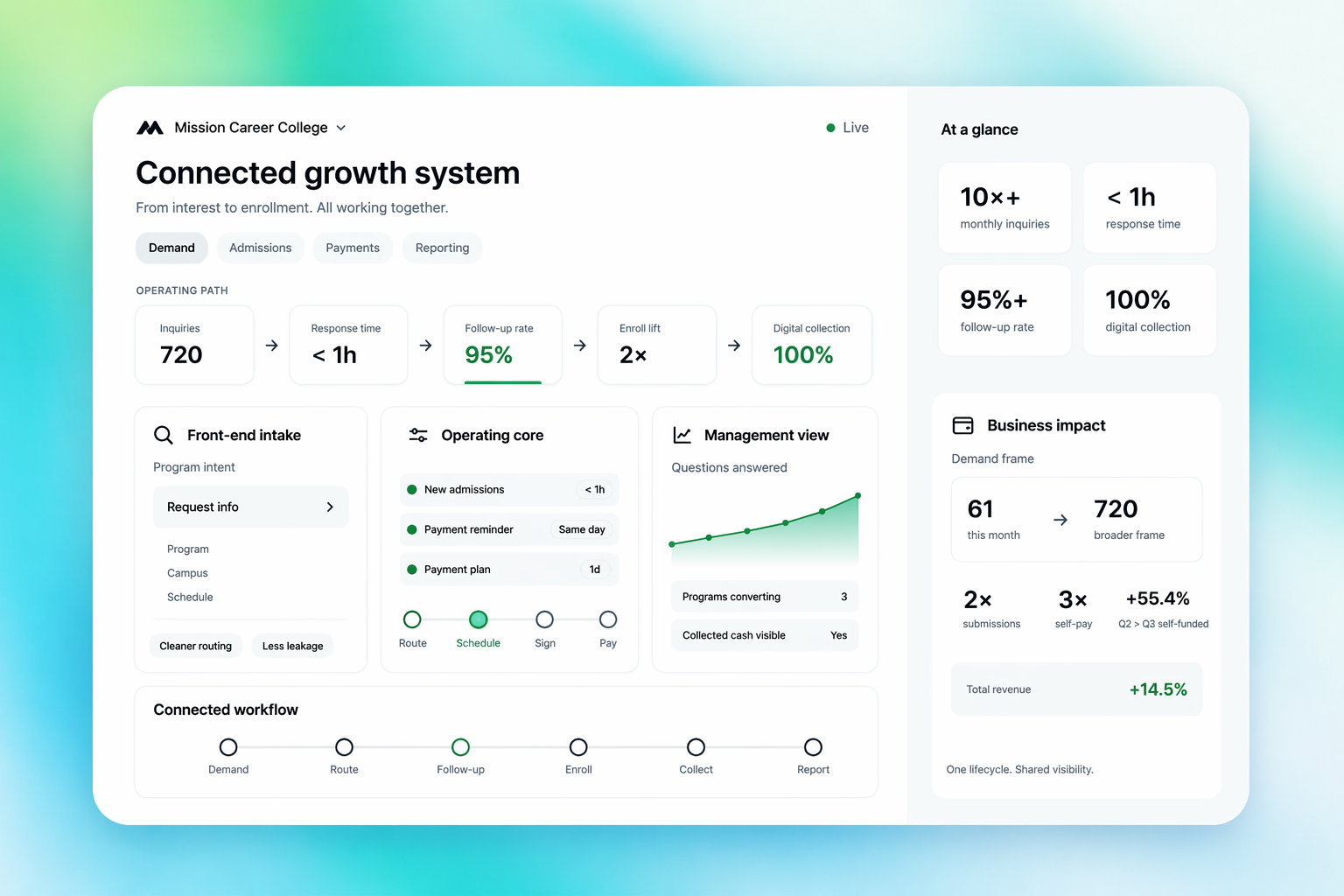
Mission Career College documented that 95 percent of leads were responded to within 24 hours, with average first-response time of approximately six hours. January 2026 reached 821 inquiries, up from 61 in January 2025, which shows the level of operational load the new workflow had to support.
One internal reporting set documented 259 enrollment submissions and 192 students attributed to digital discovery. Lifecycle sequencing also re-engaged 11 of 300 dormant leads in an early program, showing that the workflow supported both new demand and recovery of previously inactive prospects.
Quarterly operating materials showed 55.4 percent self-funded revenue growth and 14.5 percent total revenue growth over the same period. HubSpot did not create every business outcome on its own, but it sat at the center of the system that made those outcomes more manageable, more visible, and more repeatable.
Scope of work
- Admissions pipeline architecture
- Lead routing and owner assignment
- Personalized nurture workflows
- Scheduling automation
- Integrated enrollment-flow design
- Document and e-sign workflow implementation
- Class and waitlist logic
- Tuition-status and payment reminder workflows
- Re-engagement sequences
- Leadership reporting and operating visibility
Measurement note
This article is based on internal HubSpot and RevOps operating summaries, reporting captures, and public-safe implementation records prepared during 2026. The published version preserves the strongest operational evidence while omitting student-level data and unnecessary private detail.
Closing thought
When inquiry volume rises, admissions complexity does not stay hidden for long. The question is whether the system behind the team can absorb that complexity without losing speed, context, or control.
.png)